
Reviewed by Dr. Rey Junco, D.Ed. — trauma therapist specializing in complex PTSD, health anxiety, and relational trauma.
A structured, high-feedback group for adults who want to change how they relate to people personally and professionally.
You might already know your relational patterns. You notice when you over-accommodate, avoid conflict, scan other people’s reactions, or hold back what you actually think. You can explain why these patterns developed, but when tension happens in real time, the old response still takes over.
Dr. Rey Junco’s Wednesday evening interpersonal process group therapy at Concord Counseling Associates is designed for adults who want to work with those patterns directly. This is trauma-informed group therapy in Concord, MA, for people who are ready for active relational work. The focus is not only what happens in your life outside the room. It is also what happens between members during the session.
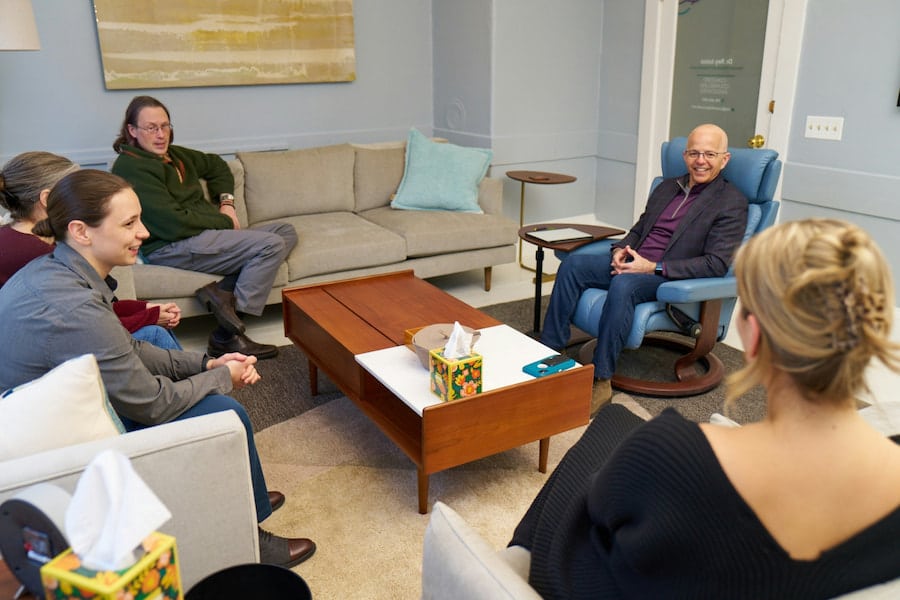
A different kind of group therapy
Support groups often center on shared experience, encouragement, and coping. In an interpersonal process group, the relationships inside the group become part of the therapy.
The group functions as a social lab. Members notice their thoughts, feelings, and reactions toward each other in real time. You get to see how you impact others, where you make assumptions, and how your familiar patterns emerge in the room. Then you have a chance to try something different while the interaction is still alive.
That kind of feedback is hard to get elsewhere. Friends often protect your feelings. Coworkers filter what they say. Employees rarely challenge you directly. In the group, you can hear how you actually come across and work with that information immediately.
Who this group is designed for
This group is best suited for self-aware adults who want root-cause relational work. Many members function well externally but feel disconnected, tense, or not quite right inside.
It can be a strong fit if you are working on:
- People-pleasing and difficulty asserting yourself
- Relational trauma or complex trauma
- Narcissistic abuse recovery
- Social anxiety in real-life interactions
- Conflict avoidance or fear of disappointing others
- Shame, self-doubt, or a harsh inner critic
This group is especially relevant for high-achieving adults whose relational patterns affect both personal life and professional growth. The work can support clearer communication, better conflict navigation, stronger boundaries, and more emotional precision under pressure.
What happens in session
There is no fixed weekly topic or worksheet. The work develops through what members bring into the room and what happens between members during the group.
A small moment can become clinically useful. You might feel irritated with someone, but try to hide it. You might feel left out and assume no one wants to hear from you. You might rush to comfort someone instead of saying what their words brought up for you.
Dr. Junco helps the group slow those moments down. Members examine the dynamic while it is happening, receive direct feedback, and practice new ways of responding. Over time, this creates more than insight. It creates repeated opportunities for deep, meaningful change.
Led by Dr. Rey Junco
The group is facilitated by Dr. Rey Junco, founder of Concord Counseling Associates. Dr. Junco is a Harvard Fellow, Oxford Visiting Faculty member, a member of the Northeastern Society for Group Psychotherapy (NSGP) Training Committee, and Master ART Certified trauma therapist with more than 25 years of experience in trauma-focused therapy.
His work combines deep relational and psychodynamic therapy with evidence-based trauma treatment. He specializes in helping high-achieving adults who are used to functioning at a high level while carrying complex trauma, relational pain, or internal distress that others do not easily see.
Group details
The current interpersonal process group meets on Wednesday evenings at Concord Counseling Associates in Concord, Massachusetts.
- Wednesdays
- 90-minute sessions
- $150 per session
- Three-month initial commitment
- Closed group format
- Strict confidentiality
- No outside socializing between members
Because this is a closed clinical group, fit matters. Prospective members meet with Dr. Junco before joining to discuss what they are looking for and whether the group is a good fit.
Taking the next step
If you are looking for group therapy for relational trauma, people-pleasing, narcissistic abuse recovery, or social anxiety, this group offers a more active way to work with the patterns that keep repeating.
At Concord Counseling Associates, Dr. Rey Junco offers interpersonal process group therapy for adults who want honest feedback, deeper self-awareness, and real-time practice in changing how they relate. To ask about the current Wednesday evening opening or future group availability, reach out to schedule a consultation.
Questions you may have about the interpersonal process group
How is interpersonal process group therapy different from a support group?
A support group usually focuses on shared experience, encouragement, and coping. Interpersonal process group therapy focuses on the live dynamics between group members. We look at what happens in the room as it happens.
Who is this group a good fit for?
This group is a good fit for adults who are self-aware and ready for deeper relational work. Many members are working on people-pleasing, relational trauma, narcissistic abuse recovery, social anxiety, or repeated relationship patterns.
What happens during a group session?
Members talk with each other about what is happening in their lives and what is happening inside the group. Dr. Junco helps members notice patterns in real time, receive feedback, and experiment with new ways of responding.
Is the group confidential?
Yes. Confidentiality is required. Members are also expected not to socialize with each other outside the group, which keeps the work boundaried and clinically focused.
How do I join the Wednesday evening group?
The group is closed, so openings are intentional. You can reach out to Dr. Rey Junco to schedule a consultation and discuss whether the group is the right clinical fit.
Reviewed by Dr. Rey Junco, D.Ed.
Dr. Junco has spent much of his career studying how people think, behave, and respond to stress, and he brings both academic research and clinical experience to his work with trauma and emotional regulation.
References
Bernard, H., Burlingame, G., Flores, P., Greene, L., Joyce, A., Kobos, J. C., Leszcz, M., MacNair-Semands, R. R., Piper, W. E., Slocum McEneaney, A. M., & Feirman, D. (2008). Clinical practice guidelines for group psychotherapy. International Journal of Group Psychotherapy, 58(4), 455–542. https://doi.org/10.1521/ijgp.2008.58.4.455
Burlingame, G. M., Strauss, B., & Joyce, A. S. (2013). Change mechanisms and effectiveness of small group treatments. In M. J. Lambert (Ed.), Bergin and Garfield’s handbook of psychotherapy and behavior change (6th ed., pp. 640–689). Wiley.
Mahoney, A., Karatzias, T., & Hutton, P. (2019). A systematic review and meta-analysis of group treatments for adults with symptoms associated with complex post-traumatic stress disorder. Journal of Affective Disorders, 243, 305–321. https://doi.org/10.1016/j.jad.2018.09.059
Schwartze, D., Barkowski, S., Strauss, B., Knaevelsrud, C., & Rosendahl, J. (2019). Efficacy of group psychotherapy for posttraumatic stress disorder: Systematic review and meta-analysis of randomized controlled trials. Psychotherapy Research, 29(4), 415–431. https://doi.org/10.1080/10503307.2017.1405168
Yalom, I. D., & Leszcz, M. (2020). The theory and practice of group psychotherapy (6th ed.). Basic Books.