
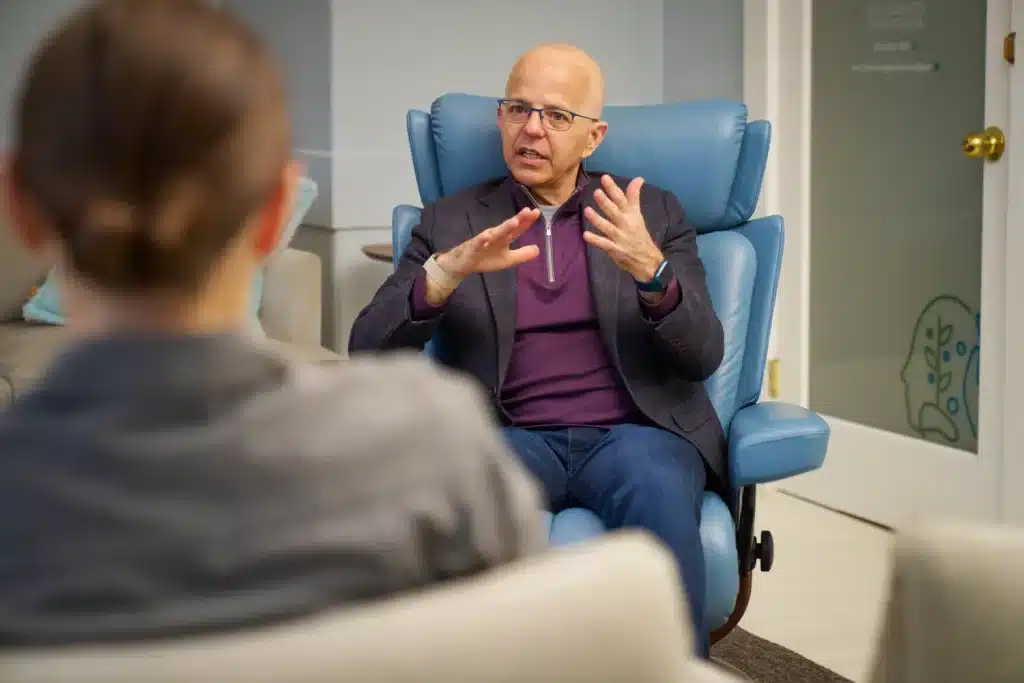
Spanish-speaking therapy supports culturally safe care by letting you describe your life in the language you actually lived it in. Many bilingual adults find that their earliest and most painful memories are stored with the words, phrases, and family expressions of their first language. When therapy can follow you into that language, and into the cultural context around it, you spend less energy translating and more energy healing.
Culturally safe care goes a step further than bilingual care. It means you don’t have to explain or defend your family, faith, or background before your therapist can understand what you’re saying.
Key points
- One in four Massachusetts residents age 5 and older speaks a language other than English at home.
- A systematic review found that language-concordant care was linked to better outcomes in most of the studies it examined.
- Research on bilingual speakers suggests that emotions often carry more weight in a person’s first language.
- Concord Counseling Associates offers trauma therapy in English and Spanish, in person and virtually.
Language is part of how we remember
Massachusetts is a multilingual state. According to the U.S. Census Bureau, 14.5% of residents identify as Hispanic or Latino, and 25.1% of residents age 5 and older speak a language other than English at home (U.S. Census Bureau, QuickFacts). For many of those families, Spanish is the language of the kitchen table, of prayer, of comfort, and of conflict.
That matters in therapy because emotion and language are closely connected. Research on bilingual speakers suggests that words learned in childhood often carry more emotional intensity than words learned later (Pavlenko, 2012). Many people notice this themselves: describing a painful memory in English can feel strangely distant, while the same story in Spanish lands with full force.
Distance can be useful early in treatment. But if the most important material always stays in translation, therapy can miss the very thing you came to heal.
Dr. Rey Junco, who grew up in a Cuban family, described on our video series how much meaning a single word from home can hold:
“So, linden is in Spanish it’s tilo or at least Cuban people call it tilo. And when I grew up, tilo cured everything.” — Dr. Rey Junco, Spilling the Tea, Ep. 1 (2:11)
Whitney Polich, LICSW, answered with a thought that captures what culturally safe therapy aims for:
“I was just thinking what the like trauma therapy equivalent would be of tilo. Probably like compassion.” — Whitney Polich, LICSW, Spilling the Tea, Ep. 1 (2:40)
What the research says about language-concordant care
When a patient and clinician share a language, it’s called language-concordant care. A systematic review in the Journal of General Internal Medicine examined 33 studies and found that 25 of them linked language-concordant care to better outcomes, including improved understanding, satisfaction, and mental health measures (Diamond et al., 2019).
The evidence isn’t uniform, and it’s worth being honest about that. A separate review of 38 studies, published in Medical Care Research and Review, found results split between positive associations and no association, with many studies limited by their design (2019 review). Language alone doesn’t guarantee good care. What seems to matter is language combined with genuine understanding.
What makes care culturally safe
Culturally safe care isn’t just speaking Spanish. It’s a way of working in which your background is treated as context, not as a problem to be corrected. In practice, that can look like:
- Understanding family loyalty, obligation, and respeto without labeling them as unhealthy by default.
- Making room for faith, spirituality, and traditional healing practices that are meaningful to you.
- Recognizing how immigration, acculturation, and code-switching shape stress and identity.
- Allowing you to move between English and Spanish freely, even mid-sentence.
Many bilingual clients prefer to switch languages depending on the topic. Some speak about work in English and their childhood in Spanish. That isn’t a barrier to good therapy. It’s useful information about how your experiences are organized.
Trauma therapy in Spanish
Trauma approaches like EMDR, Accelerated Resolution Therapy (ART), and Internal Family Systems (IFS) can all be conducted in Spanish. In some cases, working in your first language helps reach memories and beliefs that feel locked away in English. A belief like “no sirvo para nada” can carry a weight that “I’m worthless” never quite captures.
The therapeutic relationship matters here too. Research consistently shows that the strength of the working alliance predicts outcomes across therapy types (Flückiger et al., 2018). Feeling understood in your own language and culture is part of how that alliance forms.
Spanish-speaking therapy in Concord, MA
At Concord Counseling Associates, therapy is available in English and Spanish. Ofrecemos terapia en español. We see clients in person at 18 Main Street in Concord and through secure virtual sessions throughout Massachusetts and New Hampshire.
We are an out-of-network practice and provide monthly superbills you can submit to your insurance for possible reimbursement. Our fees and policies page has details.
If you’ve been looking for a therapist who understands both your language and your story, schedule a free consultation.
Read more like this
- How to choose a private trauma specialist in Concord, MA
- Trauma / PTSD therapy in Concord
- What is high-functioning trauma and how does it affect successful adults?
- How EMDR therapy reprograms trauma responses in the nervous system
Connect with Concord Counseling Associates
Watch Spilling the Tea with Rey & Whitney on YouTube · Find Dr. Junco on Psychology Today · Follow us on Facebook, TikTok, and Instagram
Related information
Diamond, L., Izquierdo, K., Canfield, D., Matsoukas, K., & Gany, F. (2019). A systematic review of the impact of patient–physician non-English language concordance on quality of care and outcomes. Journal of General Internal Medicine, 34(8), 1591–1606.
Patient–provider language concordance and health outcomes: A systematic review, evidence map, and research agenda. (2019). Medical Care Research and Review.
Flückiger, C., Del Re, A. C., Wampold, B. E., & Horvath, A. O. (2018). The alliance in adult psychotherapy: A meta-analytic synthesis. Psychotherapy, 55(4), 316–340.
Pavlenko, A. (2012). Affective processing in bilingual speakers: Disembodied cognition? International Journal of Psychology, 47(6), 405–428.
U.S. Census Bureau. (2025). QuickFacts: Massachusetts.
Tags: Spanish-speaking therapist Massachusetts, terapia en español, bilingual therapy, Latino mental health, culturally safe care, language-concordant care, trauma therapy in Spanish, Concord MA therapist, Concord Counseling Associates, Spilling the Tea with Rey and Whitney